
The State of the Rates | What My First Mortgage Taught Me
My first mortgage rate was 8.25%.

It was 2000, and I was buying my first home. The question driving my decision was simple: Can I comfortably afford the payment?
I knew my interest rate, but I wasn’t obsessing over it or trying to predict the perfect moment to buy. I was looking at the monthly expense and whether it worked for my life.
That experience still shapes my perspective today. Rates matter. They influence both the payment and the long-term cost of borrowing. But when I think about buying a home, I keep coming back to what those numbers mean for the person making the payment.
A little history helps explain why mortgage rates can feel so different depending on when you first experienced homeownership.
1981: The national weekly average for a 30-year fixed mortgage reached a record 18.63%.
2000: The annual average was 8.05%, the year I bought at 8.25%.
January 2021: The weekly average reached a record low of 2.65%.
October 2023: The weekly average reached 7.79%.
These figures come from Freddie Mac’s historical mortgage survey data, including data published by HUD. The 2000 figure is an annual average; the others are weekly milestones.
As of September 24, 2026, Freddie Mac reported a national average of 7.03% for a 30-year fixed mortgage. That’s a market benchmark; an individual borrower’s quote can differ.
If your reference point is a mortgage rate below 3%, a higher number understandably feels significant. Those exceptionally low rates left a lasting impression.
At the same time, my 8.25% mortgage in 2000 doesn’t tell us what someone can afford today. Home prices, incomes, and household expenses were different. History provides context, but your own numbers deserve the closest attention.
Here’s what a rate difference actually looks like in a payment.
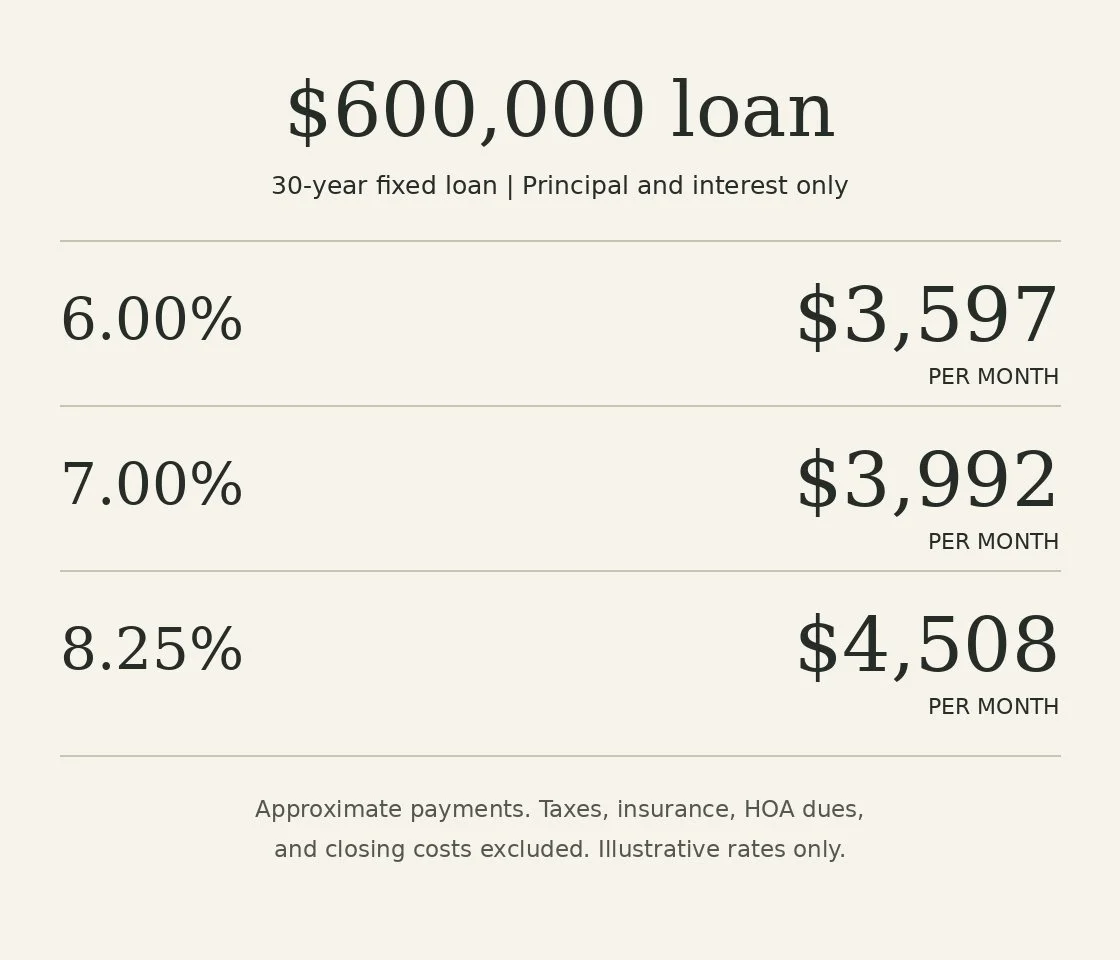
For an illustrative $600,000 mortgage paid over 30 years at a fixed rate, the monthly principal and interest would be approximately:
At 6.00%: $3,597 per month
At 7.00%: $3,992 per month
At 8.25%: $4,508 per month
The $600,000 represents the amount borrowed after the down payment, rather than the home’s purchase price. Payments are rounded to the nearest dollar. These are hypothetical examples, not loan offers, and exclude property taxes, insurance, HOA dues, and closing costs.
On the same loan amount, the difference between 6% and 7% is approximately $395 per month. That is meaningful money in a household budget.
This is why I find the payment conversation so useful. It takes a percentage and turns it into something you can evaluate alongside your other expenses and priorities.
It also brings more of the picture into focus. The amount borrowed, down payment, loan term, and interest rate all affect affordability. Property taxes, homeowners insurance, mortgage insurance when applicable, and HOA dues belong in the calculation, too.
For me, “comfortable” means there is room beyond the house payment.
Room to save. Room to handle a repair. Room for everyday expenses and the things you enjoy.
A lender’s approval is helpful information, but your personal comfort level deserves its own consideration. Two households approved for the same amount may feel very differently about making the same payment.
A few questions can help make that clearer:
What total monthly housing expense fits comfortably alongside my other obligations?
After the down payment and closing costs, what savings would remain?
Does the budget leave room for maintenance and unexpected expenses?
Would this still feel manageable if refinancing never became an option?
For some people, the answers support moving forward. For others, they point toward a different price range, a larger savings cushion, or more time. There is value in understanding that before making a commitment.
When I share my first-home story, the part that stays with me is how I approached the decision. I looked at the payment and asked whether it worked for me.
That remains my perspective today: understand the rate, understand the full cost, and give yourself room to live comfortably in the home you choose.
Thinking about a move in Nashville? I’m happy to talk through your goals and connect you with a trusted lender so you can explore the numbers at your own pace.
Meredith Smith | Your Nashville Broker
615-969-0406
Benchmark Realty, LLC | Firm: 615-510-3006
Sources: Freddie Mac Primary Mortgage Market Survey; HUD historical mortgage data; Consumer Financial Protection Bureau homebuying resources.